
Rhythm
Cockatoo drumming • animal beats • space membranes
Welcome to Twig Technology #6! This week, we’re clapping along to the rhythm. The word comes from the Greek rhythmos, meaning a measured flow or movement, an apt description for this undercurrent of both music and dance.
For more, visit twig-technology.com, or say hello to me (Dr Michael Haslam) on twitter @twig_technology.
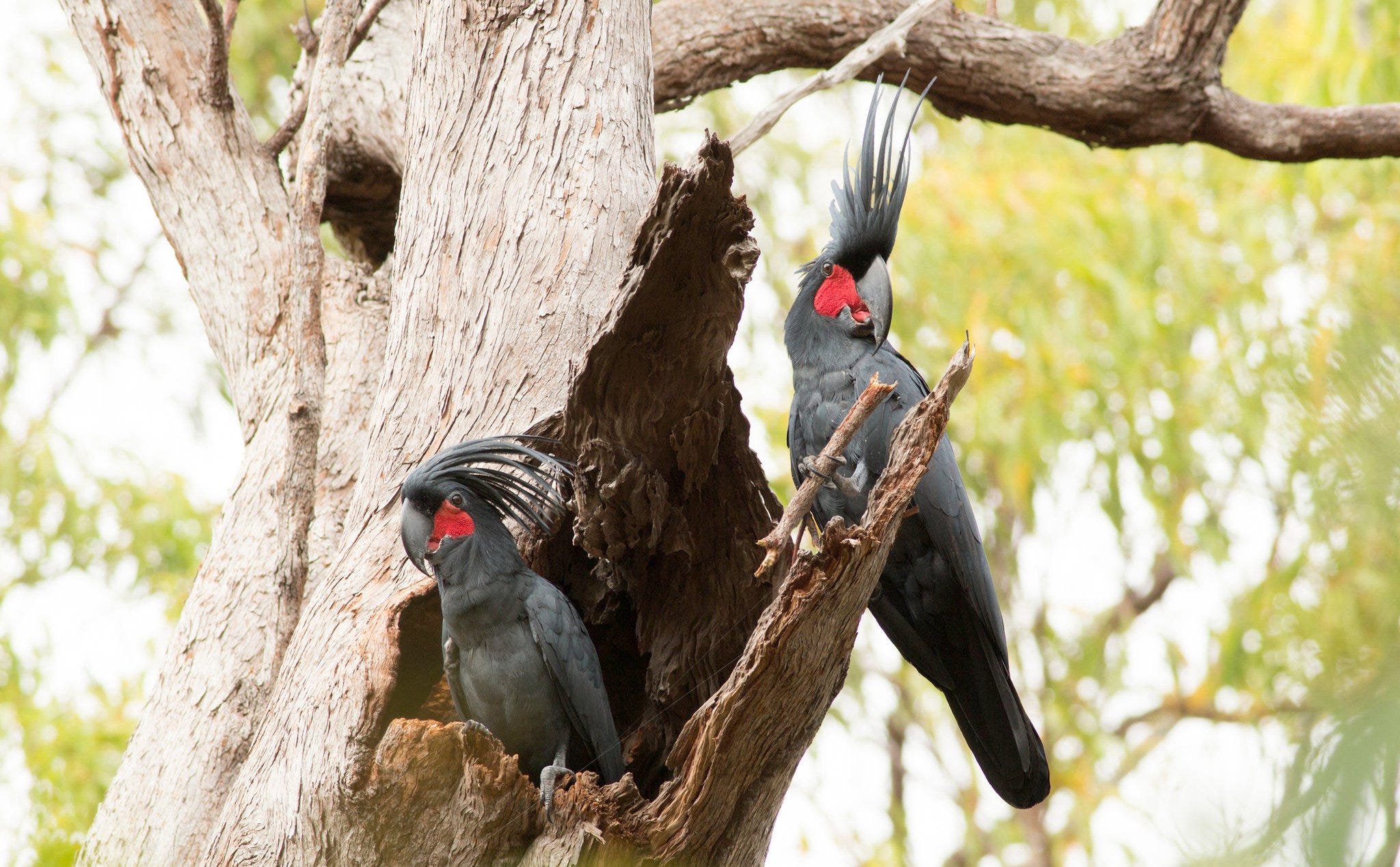
A cockatoo drumstick
Palm cockatoos are the world’s largest cockatoos, living in the rainforest remnants of northeastern Australia and New Giunea. They nest in hollow trees, within which they use thin strips of tree branches to make a supportive, porous base. But not all of the plant parts that these birds detach and strip make it into the nest. Occasionally a male cockatoo—only rarely a female—stands at the edge of the nest and uses a stick or seedpod to rhythmically tap out a beat. This makes them the only animals known to specifically make and use a tool for percussion, other than humans of course. The purpose of this banging display appears to be social, attracting a mate or signalling the presence of the bird out into the surrounding forest, up to 100m away. But it may also be an audible clue to just how good the nest itself is.
Learn more (via Twig Technology)…
Dance dance evolution
Sometimes you’ve just got to tap your foot. You may not even be consciously aware that you’re doing it, as you listen along to a favourite song. It seems the easiest thing in the world, to keep time, and matching that beat gives us a pleasant feeling of being physically part of the music. So it’s surprising that so few other animals seem able to get into the groove. Feris Jabr looks at what we know of animal beat entrainment, detailing how ‘pioneering studies have begun to elucidate how the brain tracks a beat, work that may help corroborate that rhythm is not restricted to the planet’s most loquacious creatures. The new findings suggest that rhythm has a more ancient and universal evolutionary origin than was originally thought’.
Learn more (via Quanta Magazine)…
Planetary waves
Ok this one definitely depends on your definitions, but physicist Martin Archer makes the case that he and his colleagues have found a drum tens of times larger than our entire planet. It’s formed by Earth’s magnetosphere, the magnetic field generated by our spinning planet that protects us from the worst of the solar winds. As those winds change in intensity, the edge of the field—the magnetopause—grows and shrinks, sending ripples out across the boundary. Ripples on a flexible surface: that’s the essence of a membranophone, the technical term for a drum. And Archer has even recreated what our planetary drum sounds like.
Learn more (via The Conversation)…
Video: Ronan the beat-user
In 2013, the world was introduced to Ronan, a four-year-old female California sea lion (Zalophus californianus) living at the Long Marine Laboratory of the University of California Santa Cruz. Her talent was similar to that of many human 3 and 4 year-olds: she happily bopped along to music, and she showed a clear ability to keep in time. In this video Ronan’s trainer, Peter Cook, introduces Ronan and her groovy style, which was examined scientifically using such standard testing tools as Creedence Clearwater Revival’s song ‘Down on the Corner’, ‘Boogie Wonderland’ by Earth, Wind & Fire, and of course ‘Everybody (Backstreet’s Back)’ by the Backstreet Boys.
Thanks for reading. If you think someone you know might enjoy this kind of thing, feel free to share using the link below. See you next time!