
Spears
Chimpanzee hunting • Shrike spikes • Mastodon bone
Welcome to Twig Technology #5! This week, we’re following a tip. A spear tip. The word spear comes from the Old English spere, and it’s one of a family of words that use ‘sp’ to mean a long pointy thing, including spire, spit, spike and spur.
For more, visit twig-technology.com, or say hello to me (Dr Michael Haslam) on twitter @twig_technology.
Gala-gotcha
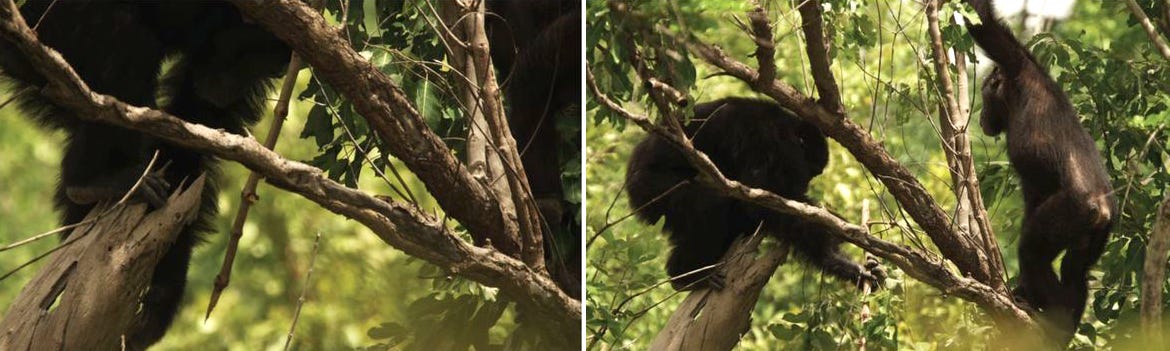
Galagos—or bushbabies—are small nocturnal primates, which means they’ve got those big nocturnal eyes that cue our protective instincts. Also, like all strepsirrhine primates, they produce their own vitamin C, while haplorhine primates like us apes need to get it from our diet. And the wild chimpanzees of Fongoli, Sénégal, have discovered that a tasty, vitamin C-rich galago snack is regularly found hiding from the daylight in deep tree holes. When they can’t get the prey directly, the chimpanzees break off and then trim a branch to form a spear, with which they stun the galago by stabbing repeatedly into the bushbaby hideout. It takes years to perfect the practice, and, happily for our protective instincts, most galago hunts actually end in failure.
Learn more (via Twig Technology)…
Shrike spike
In high-speed, you can see how the predator clamps down on the neck of its victim, then whips its head back and forth violently enough to produce around 6g of force. The neck snaps, the kill made. Maybe you’ve seen a crocodile do this, or a shark, but what about a small bird? The shrike is a carnivorous perching-bird, for whom the Latin origin of its genus name Lanius—’butcher’—is apt. Justine Hausheer from The Nature Conservancy tells us more: “Shrikes might hunt like raptors, but they lack talons to pin their prey down. And when you hunt prey almost as large as yourself, that’s a serious drawback. So shrikes grasp prey in their hooked beaks and fly it to the nearest pointy object, like a cactus spike, branch, or barbed wire spike. Then they impale the animal to both immobilize and kill it.” The result is a macabre aerial larder of dead, dying and drying creatures.
Learn more (via The Nature Conservancy)…
Close to the bone
If Alanis Morisette had lived 13,800 years ago, she may have found it ironic. An old adult male mastodon, all hairy muscle and elephant tusks, brought down by human hunters in what’s now Washington state in the US. Felled by humans using a spear tipped with…mastodon bone. NPR reports on the work of Michael Waters of the Center for the Study of the First Americans at Texas A&M University, who investigated the cold case. And overcame initial skepticism: “You know, it was suggested at one point that this may have been an elk antler tine that somehow got into the bone, like there was an angry elk that charged the elephant”.
Video: Stunning narwhals
Narwhals, with their typical whale bodies and twisting-spear-capped head, seem like one of those stitched-together hybrid fantasies that travelling circuses used to tour around the countryside. But despite being quite real, the function of the narwhal’s single tusk remains something of a mystery. It has internal nerves that can pick up on chemical changes, so maybe it’s a sensing device. Or perhaps it’s a peacock tail, a signal of the size and value of a male narwhal to a potential mate. Or maybe it’s just there to whack fish. This 2017 video from Storyful News, with drone footage from the WWF in Arctic Canada, presents the case for the latter:
Thanks for reading. If you think someone you know might enjoy this kind of thing, feel free to share using the link below. See you next time!